
Accelerating into Spring

After a cool and frosty winter, the market is experiencing a boom in early 2024. As of February, approximately 56% of home sales were made in less than a month, with a median of 38 days on market. Additionally, 20% sold over list price, 21% were purchased as investments or second homes, 26% were bought by first-time homebuyers, and 33% were all-cash purchases — the highest monthly share of sales in almost 10 years.

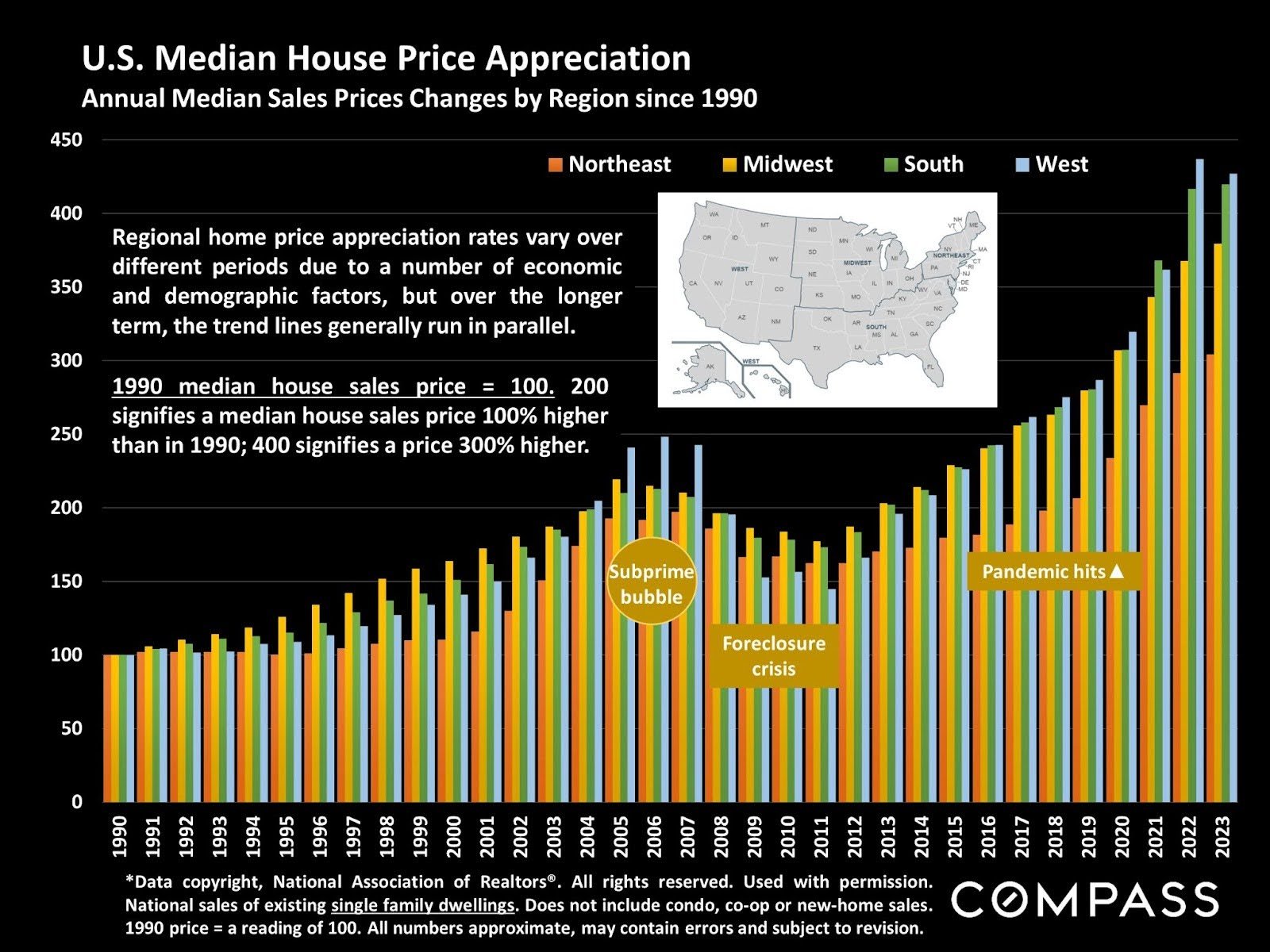
Anyone can appreciate this.

If you ever needed a visualization of the rising cost of homeownership, this chart should do the trick. Tracking median house sales price fluctuations by region since 1990, you can see a significant shift to the West and South and away from the Northeast, even as prices have appreciated across the country. Of course, the last spikes we saw in western sales led to the subprime bubble, so it’s good for investors to be cautious.

The 30-Year Fixed Dance

After peaking around 7.8% in October 2023, weekly average rates on 30-year fixed mortgages were just under 6.9% in the first week of March 2024. Any other time, we’d be singing from the rooftops, but we’re nowhere near the historic lows we saw just a few years ago. Still, any relief is good news.

Comment

Pearl You

Pearl is a stylish woman with creative inclinations. She has great eyes for property and a nose for opportunity. She excels at creative marketing and project management, and she can negotiate with the best. She understands that real estate is really about finding the lifestyle of your dreams. It’s human nature, and it drives Pearl’s work every day.

Is the market about to Spring?

Even in pandemic times, Spring has typically been a time for peaks in luxury home sales, which leads to spikes in median sales prices. As we spring into March, are we on the verge of another bump?

Leap Seconds

Did you know? What we experience as Coordinated Universal Time (or UTC) is an atomic time scale based on the performance of atomic clocks and more stable than astronomical time (or UT1), which is based on the Earth's irregular rotational rate. Whenever the difference between UTC and UT1 approaches 0.9 seconds, a “leap” second is added to correct for it. Learn more from the National Institute of Standards and Technology.